Credit Note vs Debit Note in Kenya (2026): Meaning, Examples, When to Issue Each and eTIMS
Invoices are not always right first time. A customer returns two items, a price was wrong, or you undercharged for delivery. Instead of tearing up the invoice, businesses correct it with a credit note (reduces what the customer owes) or a debit note (increases it).
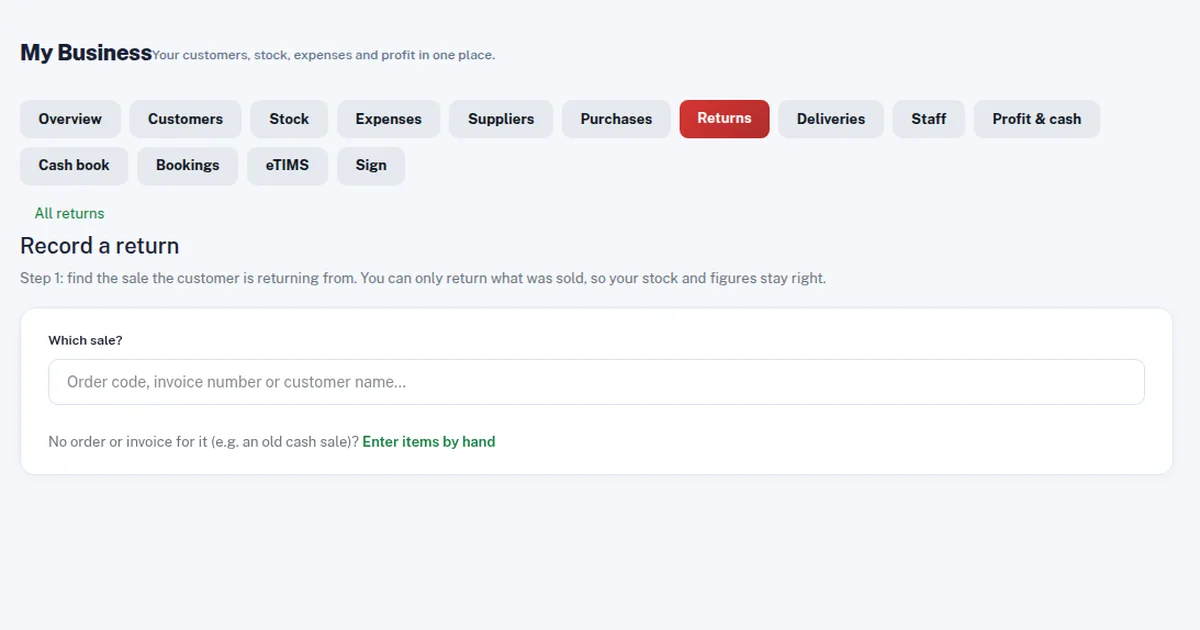
Quick answer: A credit note is issued by the seller to reduce an amount already invoiced, for example for returned goods, damaged items, an agreed discount or overcharging. A debit note increases the amount, for example when the seller undercharged; buyers also use the term for a note to a supplier claiming a reduction. Both refer to the original invoice. If the original sale was on KRA eTIMS, the correction should also go through eTIMS. Buy More Mall sellers record returns and credit notes in My Business → Returns.
Credit Note vs Debit Note: The Difference
| Credit note | Debit note | |
|---|---|---|
| Effect on the customer’s balance | Reduces it | Increases it |
| Common reasons | Returns, damaged goods, discount after invoicing, overcharge | Undercharge, extra items or charges added after invoicing |
| Issued by | The seller | The seller (extra charge) or the buyer (claim to a supplier) |
| Refers to | The original invoice | The original invoice |
| What happens next | Refund, or credit used against the next purchase | Customer pays the extra amount |
Credit Note Example
Invoice INV-2026-0042 was for 10 bags of cement at KSh 750 (KSh 7,500). Two bags arrived wet and are returned. The seller issues credit note CN-2026-0007 against INV-2026-0042 for 2 × KSh 750 = KSh 1,500. The customer now owes KSh 6,000, or gets KSh 1,500 back if they had paid in full.
Debit Note Example
Invoice INV-2026-0050 left out delivery of KSh 800 that the customer had agreed to. The seller issues a debit note for KSh 800 referring to INV-2026-0050, and the customer’s balance goes up by KSh 800.
What a Credit Note Must Include
- The words "Credit note" and a unique number.
- Date, seller and customer details, and KRA PIN where relevant.
- The original invoice number it corrects.
- Items or amounts credited, with reasons (returned, damaged, discount).
- The total credited and how it will be settled: refund or credit on account.
Credit Notes and KRA eTIMS
If you issued the original invoice on eTIMS, a correction such as a return should also be recorded as a credit note on eTIMS against that invoice, so your sales and tax records stay consistent. Rules and menus change, so confirm the current steps on KRA’s eTIMS guidance or with your tax adviser (see KRA eTIMS for small businesses).
How to Record Returns and Credit Notes on Buy More Mall
- Open My Business → Returns (Simba package and above).
- Find the sale: an online order, a POS sale or an invoice, or enter items by hand for an old cash sale.
- Choose the items and quantities returned. You cannot return more than was sold.
- Decide whether the goods go back into stock, and whether you refund the money or keep it as credit on the customer’s account.
- Save: a numbered credit note is created as a PDF, stock and profit figures adjust, and refunds appear in your cash book.
Common Mistakes to Avoid
- Editing or deleting the original invoice instead of issuing a credit note.
- Credit notes with no reference to the invoice.
- Restocking damaged goods as if they were new.
- Refunding cash without recording it.
- Forgetting the eTIMS side when the sale was on eTIMS.
Frequently Asked Questions
What is a credit note in simple terms?
A document from a seller that reduces what a customer owes on an earlier invoice, for example after a return.
When is a credit note issued?
When goods are returned or damaged, a discount is agreed after invoicing, or the customer was overcharged.
What is a debit note?
A note that increases the amount on an earlier invoice, such as for an undercharge; buyers also use it to claim a reduction from a supplier.
Can I issue a credit note on eTIMS?
Yes. If the original invoice was issued on eTIMS, record the credit note on eTIMS against it.
Is a credit note the same as a refund?
No. The credit note records the reduction; the refund is the money paid back. The credit can also be used on a future purchase instead.
Cover image: the Record a return screen in Buy More Mall My Business.
Related Guides
Recent Posts

How to Sign a Document Online in Kenya (2026): Free E-Signature, PDF on Phone or Laptop, and Is It Legal?
How to Start a Parcel Pickup Point Business in Kenya (2026): Requirements, Earnings per Parcel and How to Apply

How to Pay With PayPal in Kenya (2026): Does PayPal Work, Linking a Card, M-Pesa Top-up and Paying Online
How to Accept Card Payments in Kenya (2026): Card Machines, Online Card Checkout and PayPal for Small Businesses
Purchase Order (LPO) Format in Kenya (2026): Sample, What to Include and How to Raise One
Delivery Note Format in Kenya (2026): Sample, Template, What to Include and Proof of Delivery
Credit Note vs Debit Note in Kenya (2026): Meaning, Examples, When to Issue Each and eTIMS
How to Get an M-Pesa Statement for Business and Reconcile It With Your Sales (2026 Guide)
Projector Price in Kenya (2026): Home, Office and School Projectors, Lumens, Screen Size and How to Connect
 buymoremall
Kenya's Online Marketplace
Buy More Mall Kenya gives you a direct link to manufacturers, suppliers and service providers. Sellers are verified, there are no shortcuts, and customised orders come at affordable rates.
- Buy direct from manufacturers & suppliers
- Verified sellers and service providers
- Pay securely with M-Pesa
Shop
Sell & Earn
Help
Contact Us
- 0717 263 774
- Chat on WhatsApp
- buymoremallkenya@gmail.com
- Eastern bypass Ruiru Near Naivas super market @ kamakis & Nanyuki Neema Academy
- Contact page