Purchase Order (LPO) Format in Kenya (2026): Sample, What to Include and How to Raise One
A purchase order (PO), often called an LPO (Local Purchase Order) in Kenya, is the document a buyer sends a supplier to order goods at agreed prices. It turns a phone conversation into a written commitment, stops "I thought you said 20 bags" arguments and lets you check deliveries and supplier invoices against what you actually ordered.
Quick answer: A purchase order should include: your business name, address and KRA PIN; the supplier’s name and contacts; a PO number and date; the expected delivery date and delivery address; each item with description, quantity, unit price and line total; the order total (with VAT only if applicable); payment terms; and an authorised signature. On Buy More Mall, sellers raise numbered POs (PO-2026-0001) in My Business → Purchases, then record goods received, which adds the stock and buying price automatically.
Purchase Order Format
| Section | Example |
|---|---|
| Header | PURCHASE ORDER PO-2026-0018 · Date 18 Nov 2026 · Expected 21 Nov 2026 |
| Buyer | Your business name, address, phone, KRA PIN |
| Supplier | Supplier name, phone, email; supplier quote number if any |
| Items | 50 × Cement 50kg @ KSh 750 = 37,500 · 20 × Y12 bar @ KSh 1,050 = 21,000 |
| Totals | Subtotal, VAT (if the supplier is VAT-registered), total |
| Terms | Payment 30 days after delivery; deliver to Nanyuki shop; goods checked on arrival |
| Authorisation | Name, signature, date |
How Purchase Orders Work (Step by Step)
- Get quotes from one or more suppliers.
- Choose the supplier and raise a PO at the agreed prices.
- Send the PO (PDF by email or WhatsApp) and ask the supplier to confirm.
- When goods arrive, check them against the PO and the supplier’s delivery note.
- Record goods received: full or part delivery.
- Match the supplier’s invoice to the PO and goods received before you pay (the "three-way match").
- Pay and record the supplier payment.
LPO vs Quotation vs Invoice vs Delivery Note
| Document | Who sends it | When |
|---|---|---|
| Quotation | Supplier | Before the order: the offer (see how to write a quotation) |
| Purchase order / LPO | Buyer | To place the order at agreed prices |
| Delivery note | Supplier | With the goods (see delivery note format) |
| Invoice | Supplier | To ask for payment (see how to make an invoice) |
How to Raise a Purchase Order on Buy More Mall
Sellers on the Simba package and above find Suppliers & purchases in My Business:
- Add the supplier once (name, phone, email, what they supply).
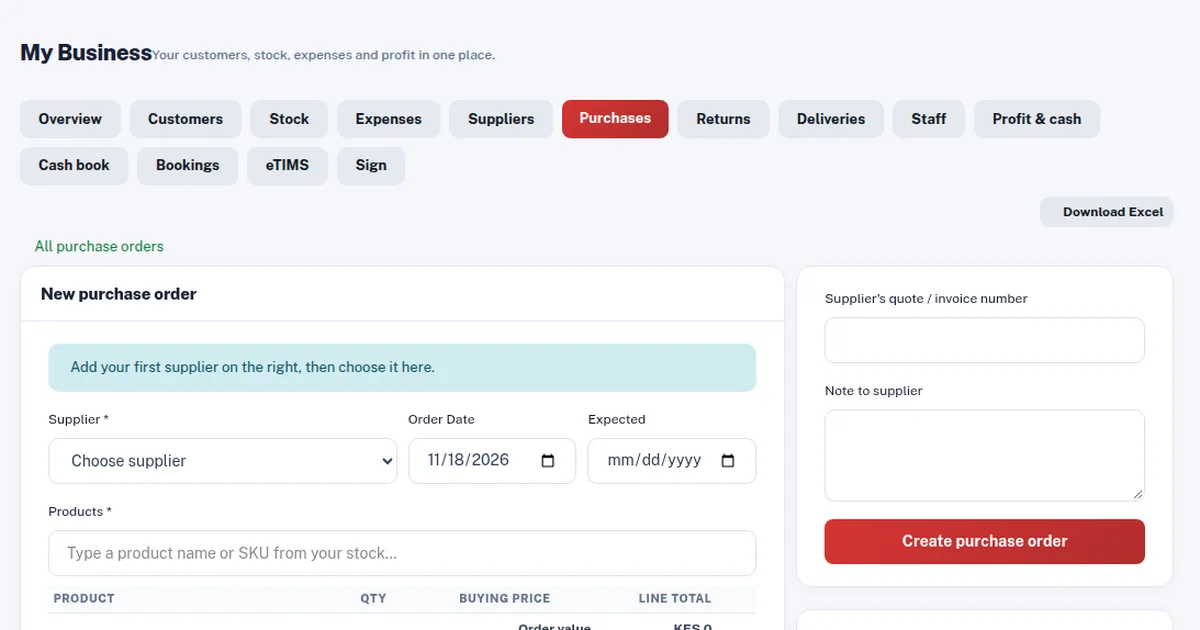
- Click New purchase order, choose the supplier, the order date and the expected date.
- Search your own products and add quantities and buying prices. The total updates as you type.
- Save and download or share the PO as a PDF.
- When goods arrive, record goods received (part or full). Stock goes up, the buying price updates and the move appears in stock history.
- Record what you pay the supplier. The supplier list shows how much you still owe each one.
Worked Example: Part Delivery Without Confusion
A hardware shop orders 100 bags of cement on PO-2026-0018. Only 60 arrive on Thursday. The owner records 60 as received, so stock shows 60 more bags and the PO stays "part received". When the last 40 arrive on Monday, she records them and the PO closes. The supplier’s invoice for 100 bags now matches exactly.
Common Mistakes to Avoid
- Ordering by phone with no written PO.
- Not stating the delivery date and address.
- Paying an invoice without checking what actually arrived.
- Reusing PO numbers.
- Forgetting part deliveries, so stock and payables are wrong.
Frequently Asked Questions
What is an LPO in Kenya?
A Local Purchase Order: the document a buyer issues to order goods from a supplier at agreed prices and terms.
How do I make a purchase order format?
Include buyer and supplier details, a PO number and date, delivery date and address, itemised quantities and prices, totals, terms and an authorised signature.
Is a purchase order a contract?
Once the supplier accepts it, it forms the basis of the agreement for that order. Keep the accepted copy.
What is the difference between a purchase order and an invoice?
The buyer sends a purchase order to order goods; the supplier sends an invoice to ask for payment.
Can I make a purchase order in Excel?
Yes, but numbering, totals and stock updates are manual. Buy More Mall sellers can raise POs that update stock automatically.
Cover image: the New purchase order screen in Buy More Mall My Business.
Related Guides
Recent Posts
How to Sign a Document Online in Kenya (2026): Free E-Signature, PDF on Phone or Laptop, and Is It Legal?
How to Start a Parcel Pickup Point Business in Kenya (2026): Requirements, Earnings per Parcel and How to Apply

How to Pay With PayPal in Kenya (2026): Does PayPal Work, Linking a Card, M-Pesa Top-up and Paying Online
How to Accept Card Payments in Kenya (2026): Card Machines, Online Card Checkout and PayPal for Small Businesses
Purchase Order (LPO) Format in Kenya (2026): Sample, What to Include and How to Raise One
Delivery Note Format in Kenya (2026): Sample, Template, What to Include and Proof of Delivery
Credit Note vs Debit Note in Kenya (2026): Meaning, Examples, When to Issue Each and eTIMS
How to Get an M-Pesa Statement for Business and Reconcile It With Your Sales (2026 Guide)
Projector Price in Kenya (2026): Home, Office and School Projectors, Lumens, Screen Size and How to Connect
 buymoremall
Kenya's Online Marketplace
Buy More Mall Kenya gives you a direct link to manufacturers, suppliers and service providers. Sellers are verified, there are no shortcuts, and customised orders come at affordable rates.
- Buy direct from manufacturers & suppliers
- Verified sellers and service providers
- Pay securely with M-Pesa
Shop
Sell & Earn
Help
Contact Us
- 0717 263 774
- Chat on WhatsApp
- buymoremallkenya@gmail.com
- Eastern bypass Ruiru Near Naivas super market @ kamakis & Nanyuki Neema Academy
- Contact page